
Key Takeaways
Choosing among the best futures prop firms 2025 requires more than comparing advertised account sizes. Rules, risk limits, evaluation structure, payout terms, and your own trading routine all matter.
- Compare drawdown rules before comparing account size.
- Treat evaluation fees as a business expense, not a shortcut to profit.
- Read funded-account rules separately from evaluation rules.
- Match the program to your trading hours and position size.
- Simulated results do not guarantee future trading success.
1. Elite Trader Funding
Elite Trader Funding is built around a clear progression: choose an evaluation, prove your strategy in a simulated environment, and move toward a funded account. Its published account plans range from $10,000 to $150,000, with no time limits stated for completing the evaluation. That structure may suit traders who prefer to work at a measured pace rather than race a countdown.
The firm says it offers six trading evaluations and that payout requests are approved daily, subject to its payout policy, terms, and internal risk controls. It also describes a path from an Elite Sim-Funded account to LIVE ELITE for qualified traders who may trade real capital. Those details make the transition model more central than simply receiving access to a simulated balance.
For readers still learning how these programs work, this futures prop firm overview explains the usual path from evaluation to funded account. The key is to treat every target and drawdown limit as a risk-management exercise, not as permission to increase size recklessly. Futures trading carries substantial risk, and hypothetical performance has clear limitations.
2. Topstep
Topstep is best assessed by the rules attached to its evaluation and funded stages, rather than by its headline buying-power figure. A trader should check the profit target, consistency requirements, maximum loss, contract limits, and payout conditions before deciding whether the format fits. These details shape the practical difficulty of the program far more than the account label alone.
The evaluation model also affects how a trader behaves under pressure. A short burst of gains may look attractive, but a repeatable process is usually more useful than one unusually large session. Risk comes before scale is a sensible standard for comparing any futures program.
When reviewing a firm, separate the cost of entry from the cost of staying active. Resets, data charges, activation costs, and recurring fees can change the real amount spent before funding. A neutral comparison should also account for whether the rules align with micros, minis, intraday trading, or a slower approach.

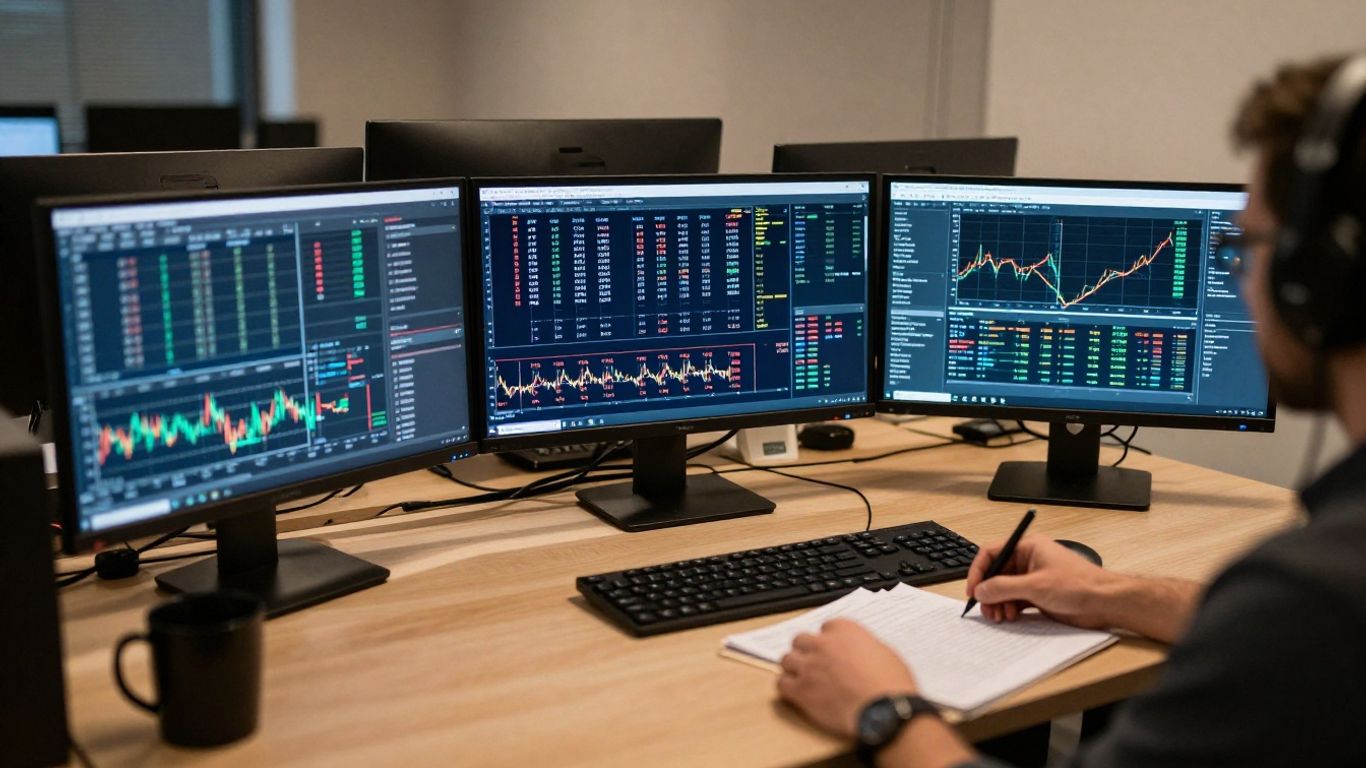
The image fits this section because platform comfort and a calm trading environment are easy to overlook. A trader who understands the rules but cannot follow them during volatile sessions still has a practical problem to solve.
3. Apex Trader Funding
Apex Trader Funding belongs on a research list for traders who want to compare evaluation structures across several well-known names. The useful questions are straightforward: how is the loss limit calculated, when can profits be requested, and what actions can cause an account breach? Those answers should come from current program terms rather than from a ranking alone.
Account size can also distort judgment. A larger notional balance does not automatically mean a trader has more usable risk, since the drawdown threshold may be much smaller. Position sizing should therefore begin with the permitted loss, the contract’s tick value, and the distance to the stop.
A practical comparison tool can help organize these differences, especially when several plans appear similar on the surface. Still, a spreadsheet cannot decide whether a trader has the discipline to stop after a losing session. That decision remains part of the trader’s process.
4. MyFundedFutures
MyFundedFutures is another name a trader may encounter while comparing futures evaluation programs. The sensible starting point is not a promotional payout figure but the current rulebook. Look for the evaluation objective, drawdown method, daily restrictions, permitted instruments, and the conditions that apply after passing.
Rules matter because they influence strategy selection. A trader who holds positions overnight needs a different program fit from one who closes every position before the session ends. Similarly, a high-frequency approach may be unsuitable where contract limits or daily loss rules make frequent entries difficult.
It is useful to write down those differences before paying for an evaluation. A simple comparison can include the following factors:
- Initial evaluation cost and recurring charges.
- Drawdown calculation and breach conditions.
- Position limits and permitted trading hours.
- Payout timing and account-stage requirements.
That list does not predict which program will be profitable. It simply makes the choice less dependent on a memorable headline or a rushed purchase.
5. Take Profit Trader
Take Profit Trader can be considered within the wider group of futures prop firms that traders research before choosing an evaluation. The important work is reading the exact rules attached to the plan being considered, since names and marketing language do not reveal how losses, payouts, or trading restrictions are handled.
A trader should also ask whether the program encourages a routine they can actually maintain. If the rules reward consistency, then a strategy built around occasional oversized positions may be a poor match. If the account has a strict daily loss limit, that limit should be reflected in the trader’s personal stop for the day.
The best futures prop firms 2025 are not necessarily the ones with the largest advertised balances. They are the ones whose conditions a trader understands, can afford, and can follow without changing a tested method every few sessions.
6. Earn2Trade
Earn2Trade is worth examining through the same practical lens: evaluation goals, risk limits, permitted trading behavior, and the transition rules that follow a pass. A familiar name does not remove the need to verify current terms. Programs can change, and a trader’s decision should rest on the plan available at the time of purchase.
The evaluation stage is also a useful test of habits. A trader who cannot keep losses within a predefined boundary may not be ready for a funded account, regardless of how attractive the nominal balance looks. Building a written daily loss rule before starting can make the process more informative.

Visual planning matters because many failures are procedural rather than analytical. Before trading, define the maximum number of attempts, the acceptable loss, and the condition that ends the session. That framework is more durable than relying on motivation after a difficult opening trade.
7. Bulenox
Bulenox can sit on a comparison list for traders evaluating different routes into funded futures trading. As with every firm in this category, the relevant details are found in the specific plan terms: the evaluation target, drawdown model, contract limits, and payout rules. A trader should avoid assuming that two similarly priced accounts operate in the same way.
The distinction between simulated trading and live capital deserves particular attention. Some programs describe a simulated funded stage, while others may outline a later route to real-market trading. Those stages can involve different conditions, so the language should be read literally rather than treated as interchangeable.
A cautious review also considers what happens after a breach or failed evaluation. Understanding reset options, account closure, and any new fees helps prevent an emotional decision immediately after a losing day. The goal is clarity before purchase, not improvisation afterward.
8. TickTickTrader
TickTickTrader is another firm that may appear in searches for futures funding programs. The name itself says little about the experience, so comparison should center on the written requirements. Check whether the plan matches the trader’s preferred contracts, session, holding period, and normal risk per trade.
The most useful account is often the one that leaves room for ordinary mistakes without encouraging careless size. Traders should estimate how many losing trades their drawdown can withstand and compare that number with their tested strategy. If the margin is too narrow, the account may create pressure that changes execution.
Research quality matters here. One can consult a broad prop firm comparison guide, but the final check should still be the firm’s current terms. Rankings are useful for discovery; they are not substitutes for contractual details.
9. Leeloo Trading
Leeloo Trading may appeal to traders who are comparing different evaluation formats, but the decision should remain grounded in fit. A trader needs to know how the account measures losses, what counts as a successful evaluation, and what restrictions apply once the account advances.
It is also worth considering the practical cost of attention. If a program requires constant monitoring, it may be unsuitable for someone trading around a job or family schedule. A plan that looks inexpensive can become costly when it encourages rushed entries or repeated resets.
A disciplined review separates facts from expectations. Published rules describe the framework; they do not promise that an individual trader will pass or receive a payout. Futures and options can produce substantial losses, and no account structure removes the need for independent risk decisions.
10. The Trading Pit
The Trading Pit rounds out this list as another name traders may investigate when comparing futures prop firm evaluations. Its place on a research list should not be read as a guarantee or a ranking of likely results. The right choice depends on the program rules and the trader’s ability to follow them consistently.
Before opening any account, write down the expected total cost, the maximum acceptable loss, and the trading schedule. Then compare those numbers with a recent sample of personal trading rather than with an idealized version of performance. This process can reveal whether the account is genuinely affordable and suitable.
A useful video search can supplement written research, but it should not replace the terms that govern an account. The safest approach is deliberate: verify the rules, practice the routine, and use only money that can be lost without creating financial hardship.
That final distinction matters across the entire category. Simulated performance is not an actual performance record, and past results or testimonials are not guarantees of future success.
Start With a Clear Plan
If you want to explore a structured route from evaluation toward funded futures trading, start your evaluation only after reviewing the plan terms and risk disclosures. Choose an account that matches your experience, trading schedule, and ability to manage losses.
Conclusion
The best futures prop firms 2025 are best compared through the details that affect daily decisions: drawdown rules, evaluation targets, contract limits, fees, and payout conditions. A thoughtful trader studies those terms, tests a repeatable process, and treats funding as a responsibility rather than a shortcut. The strongest choice is the program that fits the method you can execute consistently and affordably.
Frequently Asked Questions
What is a futures prop firm?
A futures prop firm typically offers an evaluation or trading program in which a trader follows defined rules to demonstrate risk management and trading ability. The exact account structure, funding stage, and payout terms vary by firm.
How do futures evaluations usually work?
A trader generally chooses a plan, trades under a profit objective and risk limits, and advances only if the stated conditions are met. The evaluation may take place in a simulated environment, so its results should not be treated as a guarantee of live performance.
What should traders compare first?
Start with the drawdown calculation, daily loss rules, contract limits, trading hours, evaluation cost, recurring charges, and payout conditions. These details usually matter more than the advertised account size.
Are funded trading accounts risk-free?
No. A funded program does not remove market risk, rule risk, or the possibility of losing fees paid for an evaluation. Traders should use money they can afford to lose and understand the applicable disclosures.
Is a larger account always better?
No. The usable risk may be determined by the drawdown threshold rather than the nominal account balance. A smaller account with rules that fit a trader’s method may be more practical than a larger account with unsuitable restrictions.
Can beginners trade futures through a prop firm?
Beginners can study the format, but they should first learn contract mechanics, position sizing, stops, and basic risk management. Starting with a written plan and simulated practice may be more appropriate than paying for an evaluation immediately.
Do past payouts guarantee future results?
No. Individual results, testimonials, and historical payouts do not guarantee that another trader will pass an evaluation or receive similar results. Every trader remains responsible for assessing the risks and following the current terms.