
Key Takeaways
Passing a futures evaluation is less about finding one magical setup and more about building a process that respects the account’s limits.
- Read every evaluation rule before choosing a strategy.
- Keep trade risk small enough to survive ordinary losing streaks.
- Use position size, daily limits, and stop-losses as hard boundaries.
- Trade familiar markets only when your best setups appear.
- Treat payout preparation as part of the trading plan, not an afterthought.
1. Match your trading strategy to the prop firm’s rules
The best prop firm strategy begins with the rulebook, not the chart. Before trading, write down the profit target, maximum drawdown, daily loss limit, trading hours, minimum-day requirements, and any consistency or position-size rules. A strategy that works in a personal account may fail an evaluation simply because its normal drawdown is too large.
Different evaluation structures can reward different habits. A fast intraday approach may suit a trader who can stop after one clean setup, while a slower method may need an account with room for several sessions. Elite Trader Funding describes evaluations as simulated trading challenges that test profit targets and risk management before a trader moves toward a funded account.
Read the rules as operating constraints rather than suggestions. A practical evaluation rules guide can help you compare drawdown types and minimum trading-day requirements, but the final authority should always be the current terms for the account you select. Build your plan around those terms before placing the first order.
2. Risk a small percentage of your account on each trade
Small, repeatable risk gives your strategy room to be wrong. Many traders focus on the profit target and forget that a sequence of modest losses can damage both confidence and available drawdown. Choose a fixed fraction of your evaluation balance, then reduce it further when market conditions are unusually uncertain.
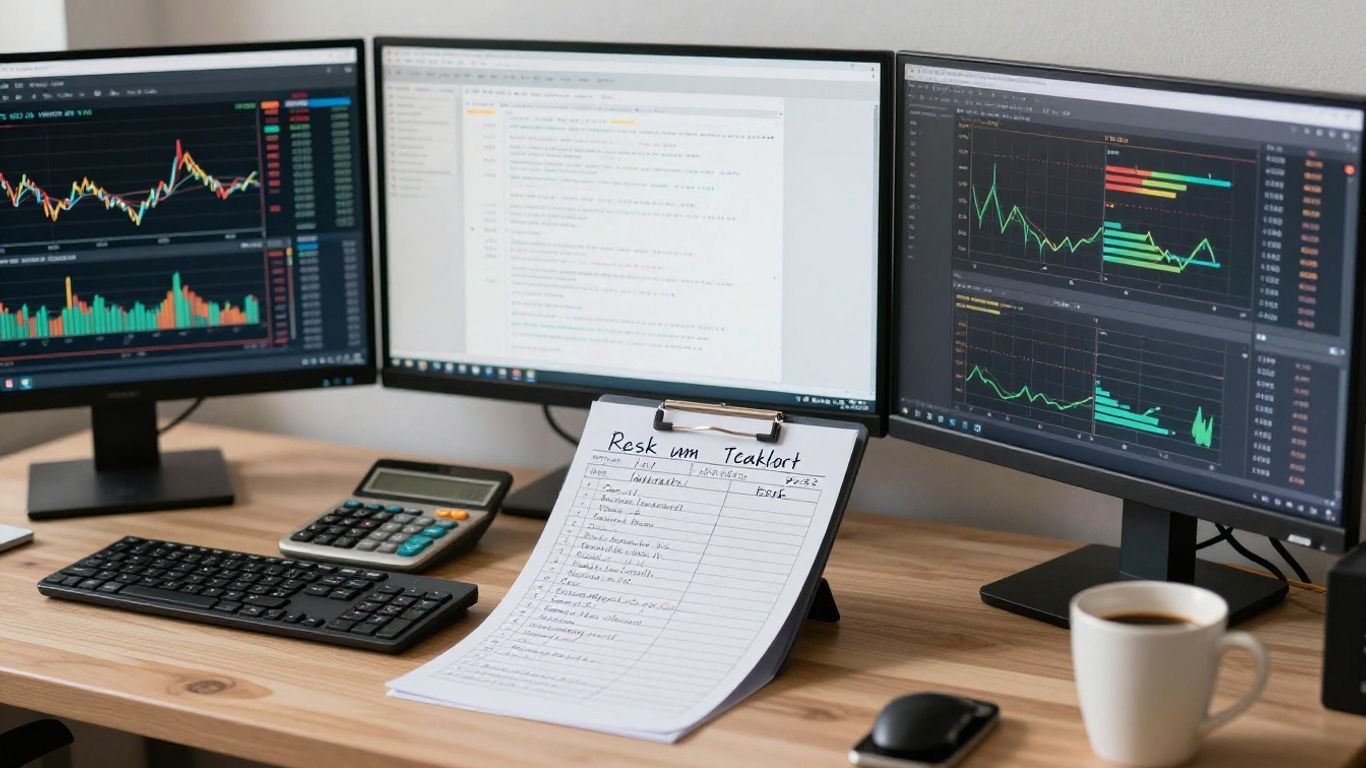
A useful risk calculation starts with the distance to your stop and the dollar value of the contract. If the stop becomes wider, the position should become smaller; if the market is too volatile for a sensible stop, skipping the trade is a valid decision. Survival comes before speed when the account has a firm drawdown boundary.
The purpose of a small risk unit is not to make every trade feel insignificant. It is to keep one mistake from forcing emotional decisions afterward. A trader who can accept several planned losses still has the mental and financial space to execute the next valid setup.
3. Set a daily loss limit before you start trading
A daily loss limit is a personal circuit breaker, even when the firm’s stated limit is larger. Set it before the session begins and include commissions, slippage, and open-trade losses in the calculation. Once the limit is reached, close the platform and review the session later rather than trying to win the money back.
The limit should reflect your normal strategy, not your most optimistic day. If your method usually takes three attempts to find a winner, risking too much on each attempt leaves no room for ordinary variance. A conservative stop-trading point protects the wider drawdown and keeps a difficult morning from becoming an account-ending afternoon.
Write down what happens when the limit is reached. There should be no negotiation, revenge trade, or sudden change in contract size. A beginner-friendly evaluation overview is useful for understanding how profit targets and drawdown limits shape the path to funding, but discipline still has to happen at the desk, one session at a time.
4. Use position sizing to control futures market exposure
Futures contracts can create meaningful exposure with relatively small price movements, so position sizing deserves its own place in the plan. Start with the maximum dollar loss you are willing to accept and work backward from the stop distance and tick value. This keeps the trade size connected to risk instead of to the account’s headline balance.
The same method can be applied across instruments, although tick values and volatility differ. A two-contract position is not automatically twice as dangerous in every situation if the stops differ, and a single contract can still be too large when the market is moving quickly. Use a calculator or worksheet before the session begins.
A simple sizing reference might look like this:
| Stop distance | Contract exposure | Practical response |
|---|---|---|
| Tight and tested | Lower planned loss | Trade only if normal noise will not hit the stop |
| Moderate | Manageable planned loss | Use the standard position size |
| Wide or volatile | Higher planned loss | Reduce contracts or skip the setup |
The table is a reminder that size is a variable, not a fixed identity. When conditions change, adjust exposure rather than forcing the same number of contracts into every market. This is the kind of mechanics-first thinking covered in a futures evaluation strategy guide.
5. Focus on one or two markets you understand
Breadth can feel productive, but watching too many markets often produces shallow decisions. Choose one or two futures markets whose session behavior, volatility, and typical setups you have studied. Familiarity helps you recognize when a pattern is genuinely present and when it only looks attractive because you are bored.
A focused watchlist also makes review easier. You can compare similar setups across many sessions without constantly changing the variables. Keep notes on the market’s active periods, average stop size, common fakeouts, and the conditions that usually make you stand aside.
The principle applies beyond futures: specialization is useful wherever outcomes depend on repeated observation. Even a guide to sports prop markets makes the broader point that research, discipline, and understanding a market’s patterns matter more than chasing every available option. For futures, fewer markets usually means clearer preparation.
6. Trade only during your highest-conviction setups
A setup is not high conviction because it appears often or because the last trade lost. Define the conditions in advance: trend or range, location, trigger, invalidation point, and acceptable reward relative to risk. If one of those pieces is missing, the trade belongs on the watchlist rather than in the account.
Waiting is an active part of the strategy. Many evaluation losses come from taking mediocre trades to stay busy, then using the best risk on a setup that arrives later. A short list of qualifying conditions gives you permission to do nothing until the market offers a recognizable opportunity.

Conviction should also include the trade’s timing. If the setup normally works during a particular session, avoid treating the same visual pattern at a quiet or irregular hour as identical. Consistency comes from repeating the same decision process, not from trading the same number of times every day.
7. Build a plan for news events and volatile sessions
Scheduled news can change liquidity, spreads, and price behavior within seconds. Decide beforehand whether you will avoid major releases, reduce size, wait for the first reaction, or trade only a tested news setup. The correct choice depends on your method and the firm’s rules, but an improvised choice is rarely helpful.
Mark economic events on your calendar and define a buffer around them. Include central-bank announcements, inflation data, employment reports, and market-specific releases that can move the contract you trade. If positions must be closed at certain times, make that part of the pre-session checklist rather than a last-minute scramble.
Volatility is not automatically opportunity. Wider movement can improve profit potential, but it can also turn a normal stop into a poor estimate of risk. When the market becomes too fast for your plan, protecting the evaluation by standing aside is a professional action.
8. Protect profits with realistic targets and stop-losses
A stop-loss should sit where the trade idea is invalidated, not at a random distance that produces an appealing position size. Place it before entry and calculate the dollar risk first. Moving it farther away after entry changes the original trade and can quietly turn a manageable loss into a serious drawdown event.
Profit targets deserve the same realism. A target based on nearby structure, typical range, or a tested exit rule is more useful than an arbitrary multiple chosen to make the evaluation finish faster. If the market reaches a reasonable objective, taking the planned profit can be better than holding for an unlikely extension.
Protecting profit also means avoiding premature risk increases. Do not double size merely because the account is slightly positive, and do not remove a stop because a winning position feels certain. A trader may hold a one-ounce silver coin as a tangible asset, but a futures position is dynamic exposure that requires active risk controls.
9. Keep a trading journal and review your performance
A journal turns scattered experiences into evidence. Record the market, time, setup, entry, stop, target, size, result, and your mental state. Screenshots are useful because they preserve what the chart looked like before hindsight edits the story.
Review the journal on a fixed schedule, preferably after enough trades have accumulated to reveal a pattern. Look for recurring errors such as entering late, moving stops, trading outside your session, or taking a second-rate setup after a loss. Separate execution mistakes from trades that followed the plan but simply did not work.
A compact review checklist keeps the process practical:
- Did the trade meet every entry condition?
- Was the position size correct for the stop distance?
- Did news or session timing change the risk?
- Did I follow the stop-trading rule?
The value of this list comes from answering it honestly, not from making the journal elaborate. Compare your notes with a professional construction checklist: scope, process, and accountability matter more than a low-effort record that cannot explain what happened.
10. Prepare for payouts by following consistency and drawdown rules
A profitable day is not the same as a payout-ready record. Before requesting money, reread the current payout policy, consistency requirements, active-day rules, and drawdown treatment for your account. Keep enough room for open trades and ordinary variance so a withdrawal does not leave the account fragile.
At Elite Trader Funding, traders first manage risk and reach a profit target in a simulated evaluation, then can move to an Elite Sim-Funded account where they trade toward a payout. The firm’s materials also describe a path in which top performers may be invited to LIVE ELITE, where qualified traders trade real capital and can withdraw daily; terms and conditions apply.
Payout preparation should therefore begin with the first trade. Keep daily results reasonably balanced, avoid a single oversized win becoming the foundation of the account, and verify every eligibility detail before submitting a request. The payout process is worth reading alongside the account’s current rules, and traders should treat all advertised outcomes as subject to policy rather than as guarantees.
CTA: Start Your Evaluation
When your plan is written and your risk limits are clear, start trading by choosing an evaluation that fits your goals and trading style.
Conclusion
The best prop firm strategy is a repeatable process: understand the rules, size positions carefully, wait for clear setups, and protect the account through ordinary losing periods. Passing an evaluation matters, but building habits that can survive drawdown and payout requirements matters more. Trade with patience, review the evidence, and let consistency—not urgency—guide the next decision.
Frequently Asked Questions
What is the best prop firm strategy for passing an evaluation?
There is no universal setup that works for every trader or account. The strongest approach is one you have tested and adapted to the evaluation’s profit target, drawdown, daily loss, trading-hour, and consistency rules.
How much should I risk on each trade?
Use a small, predetermined percentage or dollar amount that allows you to withstand several ordinary losses without approaching the account’s limits. Reduce size when volatility or stop distance increases.
Should I trade several futures markets at once?
Usually, concentrating on one or two familiar markets makes preparation and review easier. Add another market only after you understand its volatility, session behavior, and typical risk.
Is it better to trade every day during an evaluation?
Trade only when your conditions are present. If minimum trading days apply, plan for them in advance rather than forcing low-quality trades simply to increase the day count.
How should I handle major economic news?
Decide before the session whether you will avoid the release, reduce size, wait for volatility to settle, or use a specifically tested news setup. Do not improvise a new approach during the announcement.
Why do traders fail after reaching a profit target?
Common reasons include increasing size too quickly, violating drawdown rules, giving back open profit, or misunderstanding payout and consistency requirements. Keep the same risk discipline after becoming profitable.
What should a trading journal include?
Record the instrument, time, setup, entry, stop, target, size, result, and emotional state. Add screenshots and review the records regularly to distinguish strategy losses from execution mistakes.